

 Tiếng Việt

Southern Vietnamese Language Before 1975 – The Southern region before 1975 was not just a fertile land with vast rice fields and intricate canal networks, but also a melting pot of unique cultures, vividly expressed through everyday language. This way of speaking was not merely a means of transmitting information; it was also a bond connecting the community, a lens reflecting the generous and sincere soul of the people of the riverine region. Even now, despite the passage of time, the characteristic intonations and vocabulary of the “Southern language before 1975” still linger in people’s speech, recalling a bygone era filled with numerous imprints.
>>> “Strange Yet Familiar” with 7749 Southern Vietnamese Words Not Everyone Knows.
>>> Beautiful Sayings About the Southern Region: The Soul of the Riverine Area.
>>> “Taken Aback” by Pure Southern Vietnamese Sayings, as Sincere as the Southern People.
Danh mục bài viết
Southern Vietnamese Language Before 1975: Historical and Cultural Imprints in Language
To better understand the distinctiveness of the Southern Vietnamese language before 1975, we cannot overlook the historical and cultural factors that shaped it. This region was once a crossroads of various cultures, from indigenous Khmer and Cham cultures to the influence of French culture during the colonial period. This intermingling created a rich and diverse vocabulary, bearing the distinct imprints of each era.
The openness and liberality in the character of the Southern people also contributed to making the language vibrant, rich in imagery, and highly colloquial. They were not afraid to use rustic and simple words to express emotions and thoughts in the most genuine way. This created a clear distinction from the formality and rigidity of language in some other regions.
Southern Vietnamese Language Before 1975: Unmistakable Characteristics
The Southern Vietnamese language before 1975 possesses unique characteristics that allow people to recognize it immediately. One of the most prominent features is the pronunciation. The intonation often tends to be drawn out and melodic, creating a gentle, relaxed feeling, much like the flow of the rivers themselves. The differences in the pronunciation of tones, initial consonants, and rhymes also create a distinct “flavor” for the Southern accent.
Additionally, a rich vocabulary with many unique local words is also an important factor. These words are often associated with daily life, local specialties, and specific customs and practices. They not only help people communicate effectively but also carry deep cultural values.
The way Southern people express themselves is also very distinctive. They often use vivid and humorous similes and metaphors to add vibrancy and intimacy to their speech. Local proverbs and idioms are also used naturally and skillfully, demonstrating the intelligence and wit of the people.
Comparing with Current Southern Vietnamese Language: Southern Vietnamese Language Before 1975
While still retaining its basic features, the Southern Vietnamese language today has undergone certain changes compared to before 1975. Social development, strong cultural exchanges with other regions and with the world have brought new words and new expressions.
Some words that were previously less used or even disappeared have given way to more common words nationwide. However, older generations and those who cherish traditional cultural values still strive to maintain and pass on the beauty of the old language.
Differences can also be seen in terms of address, and in the use of certain particles and interjections. Words expressing respect, intimacy, and exclamation in the language before 1975 are sometimes replaced by more concise and direct expressions.
Southern Vietnamese Language Before 1975: Listing Terms Used
To give you a clearer picture, here are some terms commonly used in the Southern Vietnamese language before 1975. This list certainly cannot be exhaustive, but hopefully, it will help you visualize some of the richness of the language from that period:
Forms of Address:
- Ba, Má: Replaces Bố, Mẹ
- Cậu, Mợ: Used for mother’s older brother/sister and their spouses
- Chú, Thím: Used for father’s younger brother/sister and their spouses
- Anh Hai, Chị Hai, Anh Ba,…: Way to address siblings by birth order in the family
- Ông Cả, Bà Cả: Used for elderly people, or those with influence in the family lineage or hamlet
- Ông Tư, Bà Năm,…: Way to address people by their birth order in the family or to refer to older people
- Con: Used by adults to address much younger individuals
- Tui, Bậu: Replaces Tôi (I/me), Bạn (you/friend) (still common in some areas)
- Ảnh, Cổ: Replaces Anh ấy (he), Cô ấy (she)
- Bả: Replaces Bà ấy (she – referring to an older woman)
- Thiệt tình: An affectionate term of address among acquaintances
- Mình: Can be both a first-person singular and a second-person singular pronoun in some intimate contexts
Vocabulary for Objects, Things:
- Cái rương: Replaces a large storage cabinet
- Cái tráp: Box for jewelry, important documents
- Cái võng: Hammock for resting at noon
- Cái gáo: Ladle made from a gourd or coconut shell for scooping water
- Cái chén: Rice bowl
- Cái dĩa: Plate
- Cái muỗng: Spoon
- Cái mâm: Tray for food
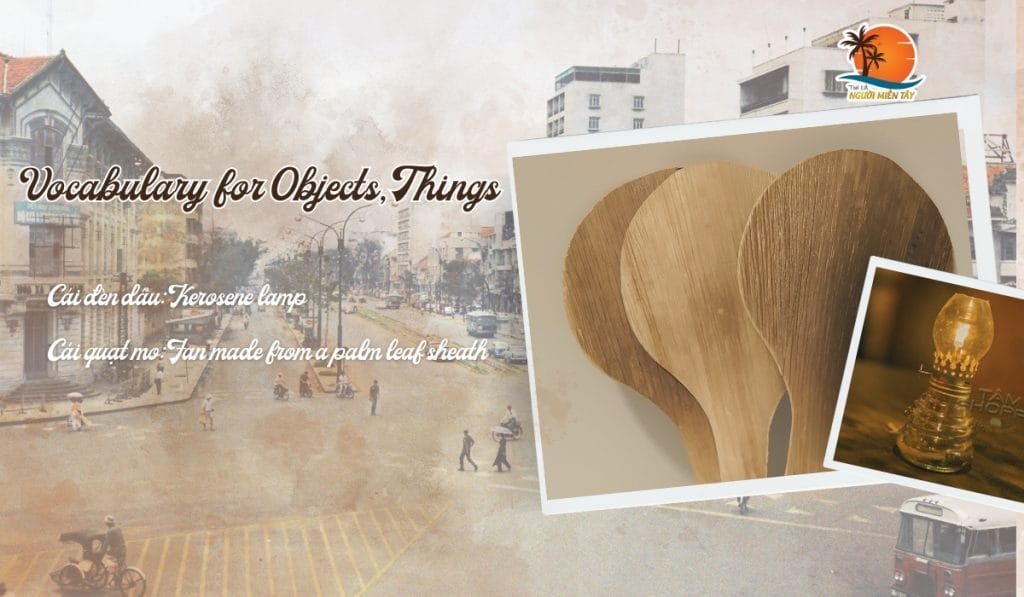
- Cái đèn dầu: Kerosene lamp
- Cái quạt mo: Fan made from a palm leaf sheath
- Cái bàn độc: Small altar table
- Cái khạp: Large jar or vat for water or rice
- Cái lu: Water jar
- Cái be: Large water barrel
- Cái ghe: Small boat
- Cái xuồng: Small boat, often used in riverine areas
- Cái tắc ráng: A type of small motorboat, fast-moving on the river
- Cái cầu khỉ: “Monkey bridge,” a bridge made of a single log or a few small bamboo poles
- Đồng hồ con gà: Wall clock with a chicken-shaped pendulum
- Ra-đi-ô: Radio (loanword from French, radio)
- Ti-vi: Television (loanword from English, TV)
- Xe đạp lô-cô: Peugeot bicycles or other French brands of that era
Vocabulary for Actions, States:
- Đi chơi: To go out, stroll, visit
- Ăn cơm: To eat rice/a meal
- Note: “Xơi cơm” is also a Northern term for eating.
- Uống nước: To drink water
- Note: “Hớp nước” is often more informal or implies a quick gulp.
- Nói chuyện: To talk, chat, discuss
- Thương: To love, cherish, value
- Ghét: To dislike, hate
- Giận: To be angry, annoyed
- Buồn: To feel sad
- Vui: To feel happy, joyful
- Khỏe: Healthy, well
- Mệt: To feel tired, lacking energy
- Nóng: Hot (temperature)
- Lạnh: Cold (temperature)
- Thấy: To see, perceive
- Nghe: To hear, listen
- Biết: To know, understand
- Nhớ: To remember, miss
- Quên: To forget
- Chờ: To wait
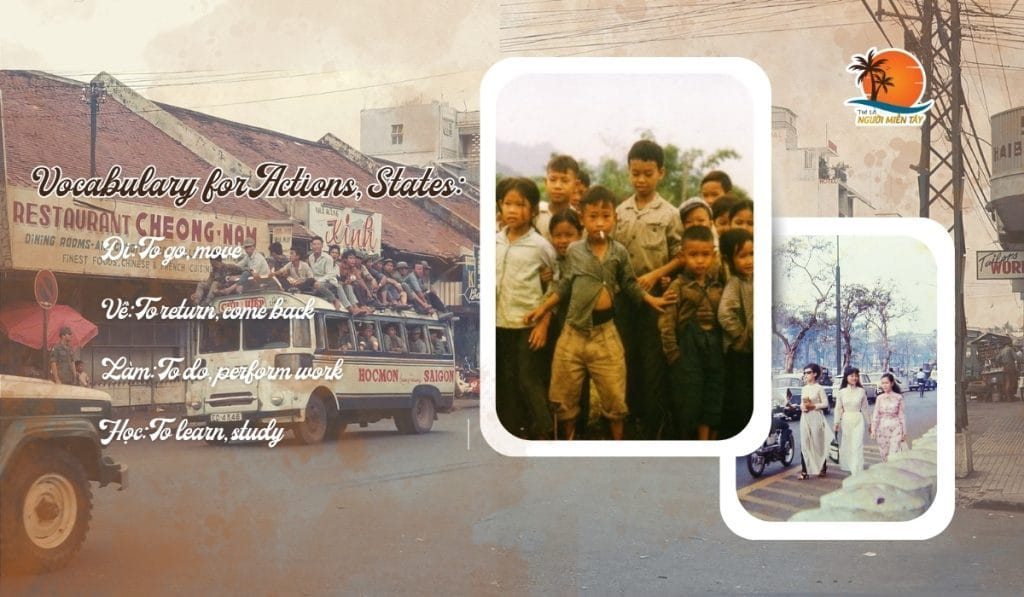
- Đi: To go, move
- Về: To return, come back
- Làm: To do, perform work
- Học: To learn, study
- Ngủ: To sleep, rest
- Thức: To be awake
- Coi: To look, watch
- Ngó: To look intently
- Dòm: To peek, look secretly
- Hỏi: To ask a question
- Thưa: To answer politely to elders
- Kêu: To call
- La: To shout loudly
- Rầy: To lightly scold
- Quở: To reprimand severely
- Giỡn: To joke, play around
- Khóc: To cry, shed tears
- Cười: To laugh, express joy
- Nín: To be silent, stop crying
- Ợ: To burp after eating
- Hỉ mũi: To blow one’s nose
- Khạc nhổ: To spit out phlegm/dirt
Vocabulary for Qualities, States:
- Đẹp: Beautiful, attractive
- Xấu: Ugly, not beautiful
- Giàu: Rich, wealthy
- Nghèo: Poor
- Lớn: Big, large
- Nhỏ: Small, little
- Thấp: Short, low
- Nhanh: Fast, quick
- Chậm: Slow
- Vui vẻ: Cheerful, lively
- Buồn bã: Sad, sorrowful
- Hiền: Gentle, kind-hearted
- Dữ: Fierce, not gentle
- Siêng: Diligent, hardworking
- Biếng: Lazy
- Khôn: Smart, intelligent
- Dại: Foolish, unwise
- Thật: True, real
- Xạo: To lie, fabricate
- Ngon: Delicious, tasty
- Dở: Not delicious, bad
- Mắc: Expensive (still common)
- Rẻ: Cheap
- Nặng: Heavy
- Nhẹ: Light (weight)
- Dơ: Dirty
- Sạch: Clean
- Đầy: Full, no more space
- Vơi: Nearly empty
- Chật: Tight, narrow
- Rộng: Spacious, wide
- Sớm: Early, before scheduled time
- Trễ: Late, after scheduled time
Particles, Interjections, Exclamations:
- À: Expresses surprise, realization
- Ờ: Expresses agreement, “uh-huh”
- Ủa: Expresses surprise, unexpectedness
- Trời ơi: Expresses surprise, lamentation (“Oh my god!”)
- Má ơi: Similar to “Trời ơi” (“Oh mother!”)
- Cha ơi: Similar to “Trời ơi” (“Oh father!”)
- Hả: Asks for repetition when something wasn’t heard clearly
- Hén: A tag question particle, “isn’t it?” (still common)
- Hông: No (still common)
- Có: The opposite of “hông” (yes/is/has) (still common)
- Vậy đó: Indicates the end of a story, “that’s it”
- Thiệt không: Asks for confirmation of truth, “really?”
- Chắc không: Expresses doubt, “are you sure?”
- Ủa mà: Expresses surprise followed by a question, “wait, but…”
- Thì: Expresses obviousness, “of course”
- Đâu có: Denies something, “not at all,” “it’s not true that…”
- Bộ: A particle asking a rhetorical question, “is it true that…?”
- Chớ: Similar to “chứ,” implying “instead” or “what else?”
Some Local Idioms and Proverbs:
- “Ăn no ngủ kỹ”: Refers to a carefree, worry-free life.
- “Nước chảy bèo trôi”: Refers to being adrift, unstable.
- “Thẳng như ruột ngựa”: Refers to a straightforward, outspoken personality.
- “Khôn nhà dại chợ”: Refers to someone who is clever at home but naive when out in society.
- “Gần mực thì đen, gần đèn thì sáng”: Refers to the influence of the surrounding environment (lit. “Near ink, one becomes dark; near light, one becomes bright”).
- “Một nắng hai sương”: Refers to hardship and difficulty (lit. “one sun, two dews”).
- “Chó treo mèo đậy”: Refers to being careful and meticulous (lit. “hang dogs, cover cats”).
- “Ếch ngồi đáy giếng”: Refers to someone with a narrow worldview (lit. “frog sitting at the bottom of a well”).
- “Thương nhau như con mắt”: Refers to loving and cherishing each other deeply (lit. “love each other like an eye”).
- “Giận cá chém thớt”: Refers to being angry at one person but taking it out on another (lit. “angry at fish, chop the cutting board”).
Cultural Value and Continuity
The Southern Vietnamese language before 1975 is not merely a system of words and grammatical rules, but an inseparable part of the cultural identity of this land. It contains historical values, the beauty in the soul, and the lifestyle of its people. Researching and preserving these linguistic values not only helps us understand the past better but also contributes to conserving and promoting the unique characteristics of the national culture.
Even as time passes and society undergoes many changes, the endearing intonations and rustic words of the Southern Vietnamese language before 1975 will continue to live on in the memories and in the speech of the people of the South. It is a testament to the vibrant life of folk culture, a bridge between the past and the present, and a source of pride for those who carry the sincere and affectionate blood of the Mekong Delta people.
>>> 6 Types of Mekong Delta River Fish, Specialties of the Riverine Region.
>>> Why is An Giang Called the “Land of Wonders” – Discovering the Magical Land.
>>> Beautiful Sayings About the Mekong Delta: The Soul of the Riverine Region.


